Create your own quilted tweed crossbody bag using this full-size PDF pattern!
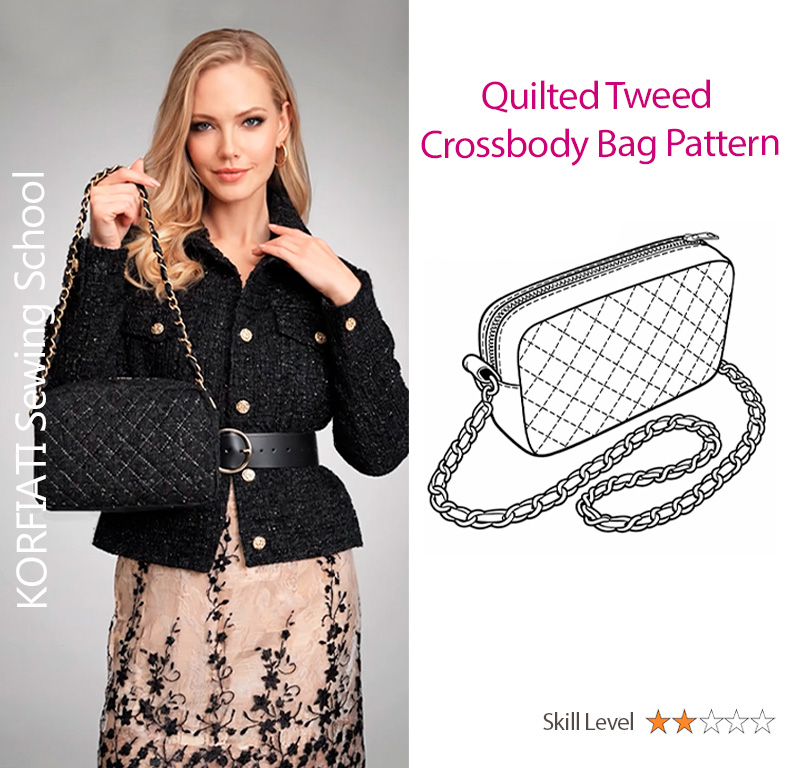
A tweed bag is more than just an accessory – it adds texture, structure, and depth to any outfit. For a cohesive look, pair it with a jacket made from the same fabric. Together, they create a polished ensemble inspired by classic French tailoring — refined, structured, and modern. The downloadable PDF pattern for the quilted bag is included in this tutorial. A coordinating tweed jacket pattern is available via the link provided.
Tweed in Accessories
Since the early 20th century, tweed has held a firm place in women’s tailoring. Beyond jackets and suits, designers began incorporating this richly textured fabric into structured accessories, including handbags. Compact chain-strap bags became icons of understated elegance, combining practicality with couture-level texture and finish. Today, quilted tweed bags remain versatile: suitable for everyday wear yet elevated enough for more refined styling. The quilting enhances structure, while the chain strap adds a classic tailored touch.

Fig. 1. Quilted Tweed Crossbody Bag: Finished Bag Measurements: 9″ х 6⅛″ х 2½″
Pattern Information
The quilted crossbody bag pattern is drafted at full scale with seam allowances included. All seam allowances are built in – no additional allowances need to be added when cutting.
Printing Instructions
The pattern sheet is shown in Fig. 2. A 5.1 cm × 5.1 cm (2″ × 2″) test square is located in the upper right corner of the pattern.
Important: When printing, select Actual Size (100% scale) in your printer settings to avoid distortion.
Print the pattern on A4 paper, assemble the pages according to the layout diagram, and verify that the test square measures exactly 5.1 cm × 5.1 cm (2″ × 2″).
You may also print the file on a large-format printer. If you do not have access to one, we recommend using a professional print or copy center.
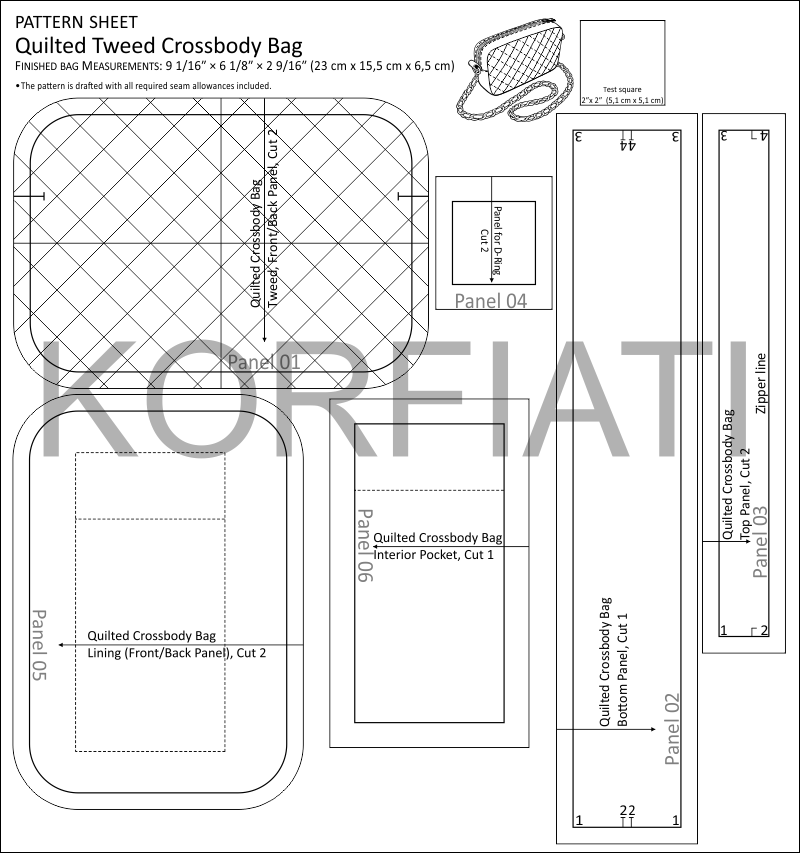
Fig. 2. Quilted Tweed Crossbody Bag – Pattern Sheet
Finished Bag Measurements: 23 cm × 15.5 cm × 6.5 cm (9″ х 6⅛″ х 2½″) . Click the icon below to download the pattern.
Download pattern
Materials & Notions
- 0.3 m (11¾″) tweed, 1.15 m (45¼″) wide
- 0.8 m (31½″) lining fabric, 0.95 m (37⅜″) wide
- 0.3 m (11¾″) fusible interfacing
- 0.3 m (11¾″) polyester batting
- 0.3 m (11¾″) hair canvas (tailoring canvas)
- 0.3 m (11¾″) fusible web (Flisofix)
- 30 cm (12″) zipper – 1
- 2.45 cm (1″) Metal D-rings – 2
- Chain strap with clasps, approx. 95 cm (37½″) – 1
- Madeira Aerofil No.120 sewing thread
- Madeira Metallic Silver No.40 quilting thread
Optional finish: Approximately 1.8 m (2 yd / 70⅞″) bias binding for finishing interior seam allowances.
Cutting
Cut all bag pieces from tweed and lining fabric. Refer to the cutting layout (Fig. 3).
- Cut pattern pieces 01–04 from tweed.
- A – Chain-Threading Binding Piece (approx. 100 cm (39⅜), 3 cm (1 3⁄16″) wide.

Fig. 3. Pattern Piece Layout on Tweed Fabric
The pattern piece layout on lining fabric is shown in Fig. 4.
- Cut pattern pieces 02, 03, 05, and 06 from lining fabric.
- B – Bias Binding (Interior Seam Finish) (75 cm (29½″), 3.5 cm (1 3⁄8″) wide.

Fig. 4. Pattern Piece Layout on Lining Fabric
Quilting & Stabilizing the Side Panels
For the side panels (Panel 01), assemble the following quilting sandwich (Fig. 5):
- Tweed
- Fusible interfacing
- Polyester batting
- Hair canvas
- Fusible web
- Lining.

Fig. 5. Quilting & Stabilizing the Side Panels
Quilt according to the marked design lines.
On one lining side panel (Panel 05), topstitch the pocket (Panel 06) in place.
Layer each quilted side panel with its corresponding lining panel. Stitch around the perimeter and treat the layers as one unit during assembly.
Professional Tip: For additional structure, insert fusible web between the quilted layer and the lining before bonding with steam. This prevents shifting and increases durability (Fig. 2).
To contents ▴Preparing the Bottom & Top Panels
For the Bottom & Top Panels (Panel 02, 03), layer the following materials in this order (Fig. 6):
- Tweed
- Fusible interfacing
- Fusible web
- Hair canvas
- Fusible web
- Lining.
- Interface the bottom panel (Panel 02) and top panels (Panel 03) with fusible interfacing and hair canvas. Bond the layers using fusible web.

Fig. 6. Quilting & Stabilizing the Top&Bottom Bag Panels
- Fold one long edge of each top panel and insert the zipper between them. Stitch in place.
- From the wrong side, attach the lining to the zipper tape.

Fig. 7. Quilted Tweed Crossbody Bag Pattern – Top Panel and Zipper
D-Ring Tabs
- Construct the D-Ring tabs (Panel 04). Insert one D-Ring into each tab and secure.
- Position the tabs at the short ends of the top section (Panel 02) between the marked points and stitch in place.

Fig. 8. Quilted Tweed Crossbody Bag Pattern – Side Panel with D-ring Tab
Final Assembly
- Join the bottom and top sections along short seams 1–1 and 3–3.
- Attach the assembled unit to the side panels.
- Trim lining seam allowances to ½″ (1.2 cm / ½″) and bind with bias tape if desired.

Fig. 9. Quilted Tweed Crossbody Bag Pattern -Interior View of the Lining
Strap Construction
- Sew the fabric shoulder strap. Thread it through the chain links and secure the ends.
- Attach the chain to the D-Rings using the clasps.
Your quilted tweed crossbody bag is complete. For a coordinating look, explore the Tweed Jacket Pattern available via the link
You’ll find even more ready-to-use patterns and wardrobe ideas on the Anastasia Korfiati Sewing School website. Subscribe to our free newsletter and be the first to receive new patterns.



No Comments