Super-trendy! Sew a Teddy Jacket with a Free PDF Pattern!
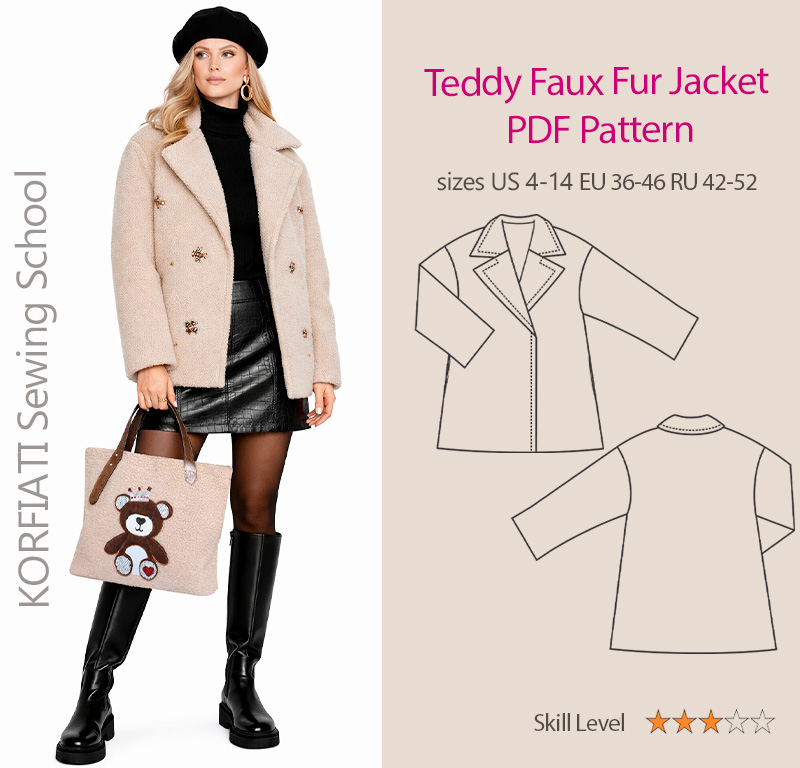
- Super-trendy! Sew a Teddy Jacket with a Free PDF Pattern!
- What is Teddy Faux Fur: Production Method and Composition
- Production Method
- Material Composition
- Teddy Faux Fur Garments and Their Place in High Fashion
- What Can Be Sewn from Teddy Faux Fur?
- Teddy Faux Fur in Designer Collections
- Teddy Jacket Details (Technical Specification)
- How to Download Teddy faux fur jacket pdf pattern
- How to Check Your Downloaded Pattern
- Cutting and Sewing Instructions
- Seam and Hem Allowances
- How to Construct the Teddy Faux Fur Jacket
Teddy fur garments are among the coziest and most sought-after trends of recent years, and their popularity shows no sign of fading. The fabric gets its name from its resemblance to the texture of a classic teddy bear: soft, slightly curly, and incredibly pleasant to the touch. In this lesson, we offer a free pdf-pattern for an original teddy fur jacket. You can download the pattern in six standard sizes and craft your own garment.
To contents ▴What is Teddy Faux Fur: Production Method and Composition
Teddy fur is a type of faux fur (eco-fur) that imitates sheepskin or shearling but has a looser, more “curly” structure. Unlike smooth faux furs like mink-style fabric, teddy fur is characterized by distinct curls and a textured, uneven surface.
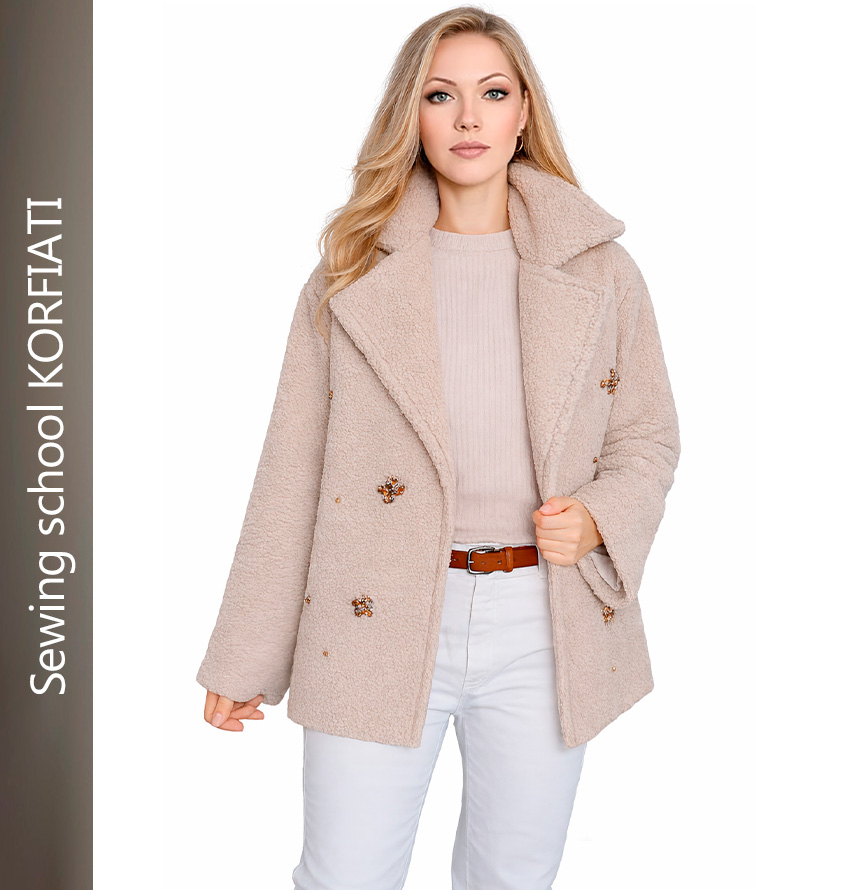
Fig. 1. Teddy fur is a type of faux fur (eco-fur) that imitates sheepskin or shearling but has a looser, more “curly” structure
Production Method
Teddy faux fur production is a high-tech process, most often based on a knitted backing technique:
- Backing: A strong knitted ground fabric is created, usually from polyester. It is elastic but retains its shape.
- Pile: Fiber tufts are integrated into the backing and then heat-treated. The heat causes the fibers to curl, forming the signature “curls” or textured surface.
- Fixing: To prevent shedding, the reverse side is often treated with a special coating or reinforced with a thin layer of knit or suede.
Material Composition
Modern teddy fur comes in different compositions, which affect its price and warmth:
- Synthetic (100% polyester or acrylic): The most common option. Durable, hypoallergenic, and affordable.
- Blended: Natural sheep’s wool is added (20–80%), making the fabric warmer and more expensive. Wool fibers are breathable, offering better thermoregulation.
- Viscose-based: Found in premium collections. This version is softer, more flexible, and has a beautiful matte sheen.
Teddy Faux Fur Garments and Their Place in High Fashion
Initially, teddy fur was associated with toys and home wear, but today it is fully embraced in high-end fashion.
What Can Be Sewn from Teddy Faux Fur?
Thanks to its flexibility and volume, teddy fur is suitable for a wide range of garments:
- Outerwear: The clear leader is the cocoon coat (Teddy Coat). Bomber jackets, cropped jackets, and oversized vests are also popular.
- Accessories: Teddy bucket hats and caps are must-haves for the fall-winter season. Tote bags and soft backpacks are equally trendy.
- Footwear: The fur is used both as trim (boot cuffs) and as the main material for home slippers or conceptual mules.
- Home décor: Pillows, throws, and furniture covers instantly add “hygge”-style coziness to interiors.
Teddy Faux Fur in Designer Collections

Fig. 2. Total look: Teddy faux fur jacket and bag by Anastasia Korfiati
FREE PATTERN ALERT! Want to create a stylish Teddy Fur Bag to match your jacket t? This is the ultimate accessory for the season! How ti get it: Just comment “I want the pattern!” below, and we’ll fast-track the release on our website! Don’t miss out on this cozy DIY project (Fig. 2).
The real boom began in 2013, when the Italian fashion house Max Mara introduced the legendary Teddy Bear Icon Coat. Designer Ian Griffiths reimagined an archival 1980-s model, and since then, this coat has become an iconic luxury item worn by global celebrities and influencers.
Other brands have also embraced teddy fur:
- Stella McCartney: as a leading advocate of ethical fashion, Stella uses high-quality eco-teddy fur that is virtually indistinguishable from real fur.
- Prada and Miu Miu: often experiment with bright, neon teddy fur colors, turning a cozy fabric into an avant-garde statement.
- Coach and Marc Jacobs: integrate teddy fur into bags and accessories, creating tactile, playful, and ironic collections.
Teddy Jacket Details (Technical Specification)
- PDF Pattern: Developed for download, covering standard sizes 42 through 52.
- Finished Center Back Length: Sizes 42/68,5 cm – 44/69 cm – 46/69,5 cm – 48/70 cm – 50/70,5 cm – 52/71 cm.
- Closure: Double-breasted.
- Internal button and loop fastening.
- Collar and Lapels: Wide lapels and a large convertible collar.
- Shoulder Line: Dropped shoulder line.
- Pockets are in the side seams.
Fabric Recommendation: Faux fur Teddy or any short pile faux fur.
Pro Tip! If you’re looking to customize a teddy faux fur garment, try embellishing the front panels with rhinestone or bead motifs. For this piece, we’ve hand-applied a variety of multi-shaped stones to create these delicate cross patterns.
To contents ▴How to Download Teddy faux fur jacket pdf pattern
The Teddy faux fur jacket pattern is drafted for six standard sizes: from 42 to 52. The ease allowance (or design ease) added to the half-bust measurement is approximately 10 cm. The ease allowance added to the sleeve width is approximately 16 cm.
Finished Center Back Length for sizes 42-52: 68,5 cm – 69 cm – 69,5 cm – 70 cm – 71,5 cm – 72 cm.
A front and back design sketch (or technical flat) of the jacket is shown in Fig. 3.
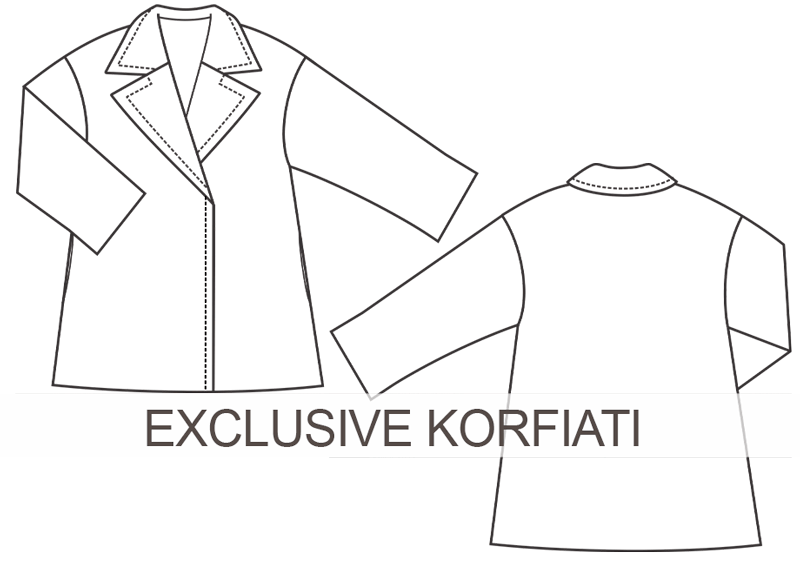
Fig. 3. Teddy faux fur jacket sketch
The ready-to-download PDF pattern is provided in two formats:
1. Full-scale (for wide-format printing).
2. Tiled (for printing on standard A4 sheets).
If you print the pattern using the A4 tiled format, the sheets must be accurately joined. A tiling grid (or alignment grid) is printed on the sheets, making assembly simple – use masking tape or a glue stick and scissors. For more details, see: How to Check Your Downloaded Pattern
IMPORTANT! The pattern pieces are drafted without seam allowances or hem allowances!
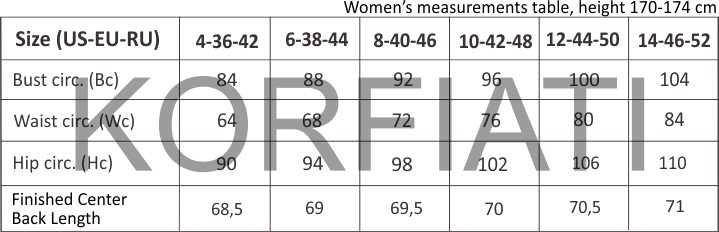
Fig. 4. Basic measurements Chart 36-46 sizes
To download The Teddy Jacket Pattern, click the icon below.
To contents ▴How to Check Your Downloaded Pattern
The complete pattern sheet layout is shown in Fig. 5. To ensure printing accuracy, a test square with dimensions of 100 х 100 mm is included on the pattern pages.
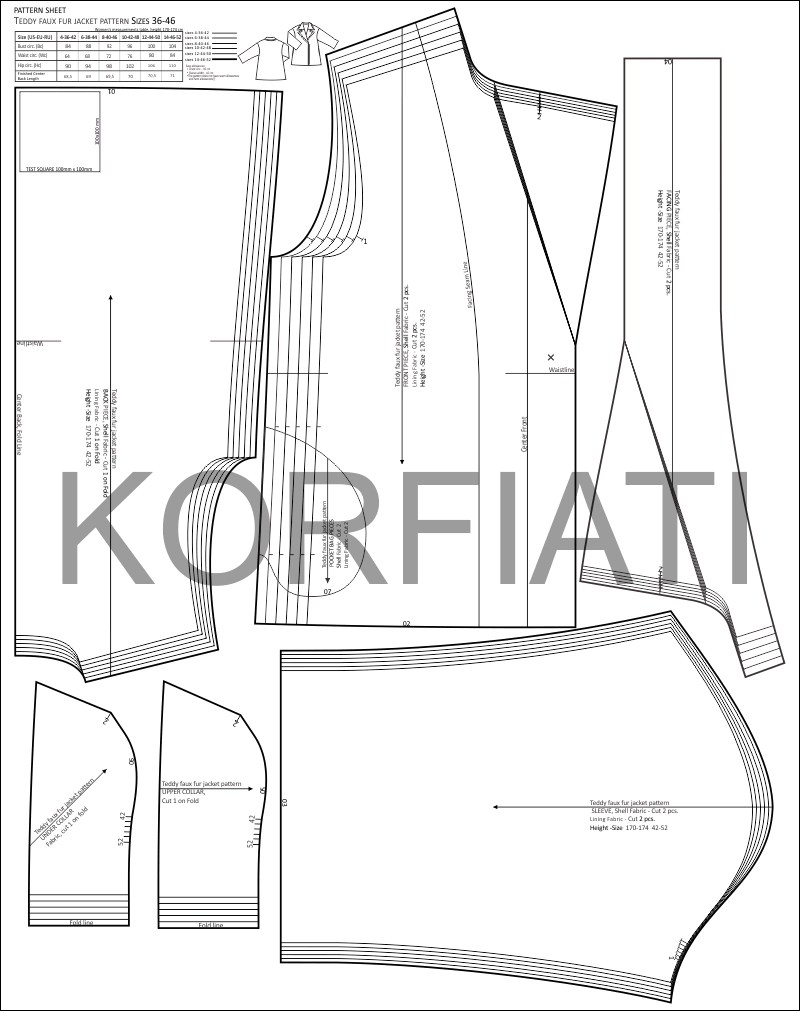
Fig. 5. The teddy faux fur jacket Sheet Pattern
Why is this necessary? Sometimes, printer settings can compress the image. Therefore, ensure that your printer settings have the “Full Size” or “Scale 100%” option selected.
Mandatory Step: Always measure the test square after printing and check the pattern pieces after assembly to avoid errors in the final garment.
Pro Tip (Muslin/Toile Check): A simple way to check the pattern is to cut out the paper pieces for your chosen size and join them at the seamlines using small pieces of painter’s tape. Carefully try on the resulting paper mock-up (or toile). This gives you a clear sense of the garment’s structure and fit (or silhouette), allowing you to easily tweak the pattern for any noticeable fit issues in girth or length.
To contents ▴Cutting and Sewing Instructions
Download and print the pattern, assemble the tiled sheets, select your size, and cut the pattern pieces along the solid lines.
Materials Required for Construction:
-
- Approximately 2.5 m of teddy faux fur (145-150 cm width).
- 1.6 m of viscose lining fabric.
- Fusible interlining (or interfacing/stabilizer) for reinforcing key pattern pieces (see tutorial: How to Fuse Interfacing).
- Thread for topstitching
- All-purpose sewing thread (e.g., Madeira Aerofil No. 120).
Required Sewing Equipment:
- Straight-Stitch Sewing Machine: For seaming and edge finishing.
Cutting Layout (Main Fabric, Fig. 6):
- Back: 1 piece (on the fold)
- Front: 2 pieces
- Sleeve: 2 pieces
- Front Facing: 2 pieces
- Upper Collar: 1 piece (on the fold)
- Under Collar: 1 piece (on the fold)
- Pocket bag: 2 pieces
Interlining: Fuse the interlining to the designated pattern pieces as shown in the diagram (Fig. 12). Additionally, fuse interlining to the hem allowances of the Back, Front, and Sleeves.
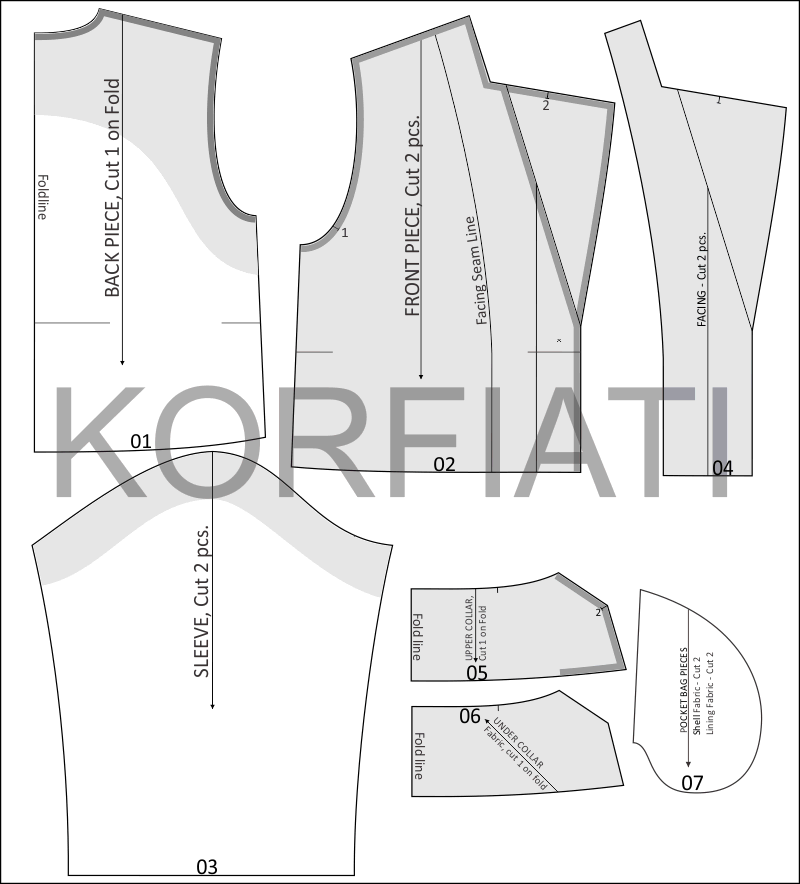
Fig. 6. The Teddy Faux Fur Jacket Pattern Details
Cutting Layout (Lining Fabric):
- Back: 1 piece (on the fold, add a pleat for ease of 2 cm at the center back).
- Front: 2 pieces.
- Sleeve: 2 pieces.
- Pocket bag: 2 pieces.
Seam and Hem Allowances
Add a seam allowance of 1,5 cm to all pattern edges. Add a hem allowance of 5 cm to the bottom edges of the Back, Front, and Sleeves.
For more detail, see the lesson: What Seam Allowances to Use When Cutting
How to Construct the Teddy Faux Fur Jacket
A detailed step-by-step construction tutorial for a similar style of transitional weight coat can be found here: How to Sew a Coat
Discover more ready-to-use patterns and styling ideas for your wardrobe on the Anastasia Korfiati Sewing School website. Subscribe to our free newsletters to receive new patterns first!


No Comments