A Perfect Beach Jumpsuit for Summer Days
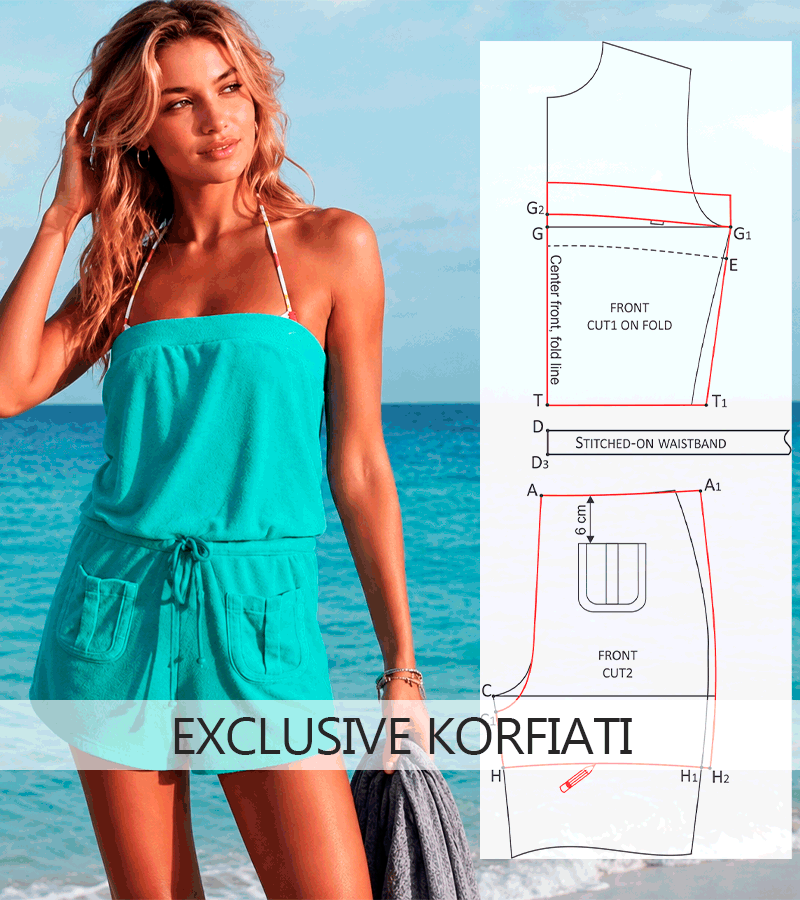
This bright summer jumpsuit is made from cotton jersey, an ideal fabric for warm-weather wear. Perfect for your vacation wardrobe, this is a great project to add to your sewing list. Light, breathable, and effortless to wear, this seaside jumpsuit is perfect for beach walks, summer outings, or relaxed afternoons at a café. It can be completed in just a couple of hours. In this lesson, you’ll find the full step-by-step pattern drafting process, along with detailed tips on fabric cutting and sewing the jumpsuit for a clean and professional finish.
How to Draft the Jumpsuit Pattern
The pattern is drafted based on the Basic Dartless Bodice Block and the Basic Pants Block. If you are drafting basic blocks for the first time, work them out on graph paper first, then trace onto pattern paper and proceed with the modeling stage. Keep your master blocks for future designs.
IMPORTANT! This model has no zipper and must be sewn only from stretch fabrics.
The side seam length from the waist is approx. 35 cm (13 3/4″).

Fig. 1. Beach jumpsuit sketch
Tip! For a better fit and hold, stitch the strap to the front of the jumpsuit.
Drafting the Front Bodice (Fig. 2)
Trace the front and back bodice up to the waistline.
- From armhole line GG1, raise point GG2 by 1.5 cm (5/8″) along the center front line (adjust depending on bust size). Draw a smooth curve G1-G2.
- Draft a grown-on facing along the upper edge, 4 cm (1 5/8″) wide at G2–K.
- Along the waistline, extend TT2 = TT1 + 3 cm (1 1/4″) (may vary depending on size). Draw the side seam G1-T2.
Drafting the Back Bodice
Apply the same adjustments as for the front bodice:
- T3T5 = T3T4 + 3 cm (1 1/4″). Draft a grown-on facing along the upper edge, 4 cm (1 5/8″) wide at G3–K1.
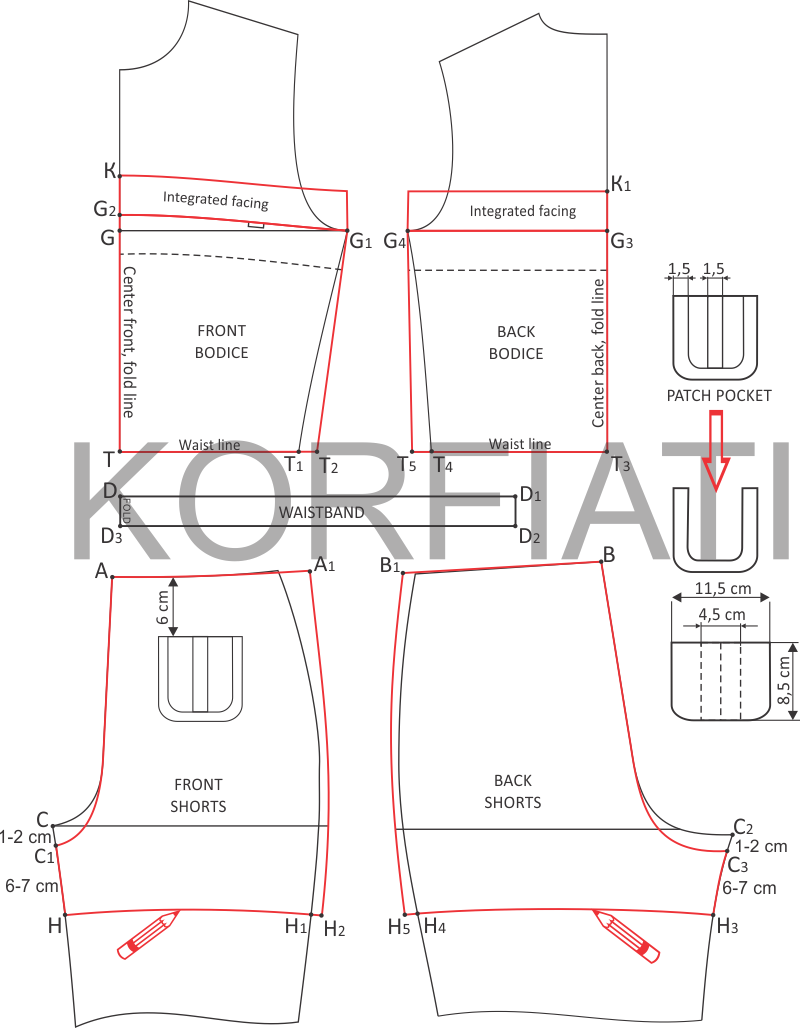
Fig. 2. Beach Jersey jumpsuit pattern drafting
Drafting the Front Shorts
- Lower the crotch curve by 1-2 cm (3/8″ – 3/4″): CC1 = 1–2 cm.
- From C1, set inseam length 6-7 cm (2 3/8″–2 3/4″).
- Extend hem width by 1 cm (3/8″): H1-H2 = 1 cm.
- At the waist: AA1 = TT2.
Shape the front shorts by connecting A-C1-H-H2-A1.
Drafting the Back Shorts
- Draft the back shorts in the same way as the front.
- At the waist: BB1 = T3T5.
- Shape the back shorts through B-C3-H3-H5-B1.
- Draft a waistband: DD1 = D2D3 = TT2 + T3T5, width = 3 cm (1 1/4″).
Drafting the Pocket
This jumpsuit features unconventional patch pockets with a shaped outer panel and a center inverted pleat (Fig. 1). Unlike traditional placement, the pockets are positioned on the front, keeping everything visible and easily accessible.
- Finished pocket size: 8.5 × 8.5 cm (3 3/8″ × 3 3/8″).
- For a 1.5 cm (5/8″) inverted pleat, add 3 cm (1 1/4″) to the inner pocket width.
Tip! Pocket size, shape, and placement can be adjusted according to design preference.
Cutting layout is shown in Fig. 3. Add 1 cm (3/8″) seam allowances and 3 cm (1 1/4″) hem allowance for shorts.
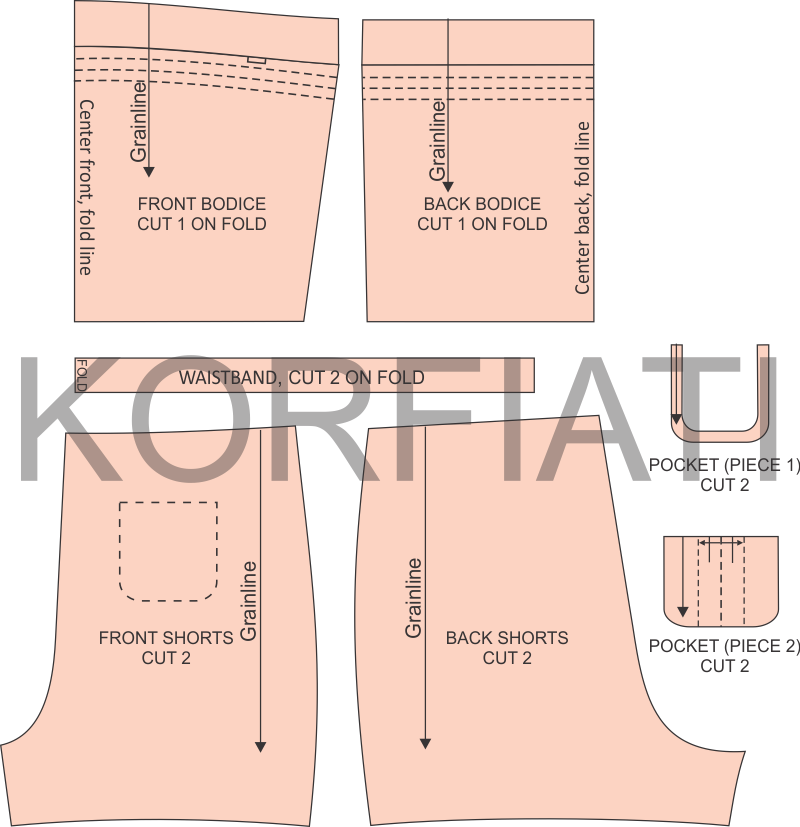
Fig. 3. Beach jersey jumpsuit pattern pieces
Materials & Notions
- 1 1/8 yd (1.0 m) cotton jersey, 57″ (145 cm) wide;
- 1/4″ (0.7 cm) elastic;
- 2 eyelets;
- waist drawstring cord;
- matching thread.
Construction of the Jersey Jumpsuit
- Sew the bodice side seams.
- Create inverted pleats on the pocket pieces and attach the outer pocket panels. Press and topstitch the upper edges. Finish raw edges on the side and lower edges, then baste in place and topstitch onto the front shorts according to the markings.
- Sew the shorts inseam and crotch seam. Sew the side seams.
- Join the outer waistband at the short ends. Press seams open. Insert eyelets at the front.
- Attach the waistband to the bodice and shorts.
- Prepare the inner waistband and press seams open; leave unstitched. Attach from the wrong side of the garment. Stitch casing channels, then insert elastic and drawstring through the opening.
Turn the grown-on facing inside, stitch along the lower edge, and sew two parallel rows for elastic casing, leaving openings. Insert elastic, adjust length, join ends, and close openings. Finish hem with a double-needle coverstitch.



No Comments